Showing posts with label Khoisan. Show all posts

Thursday, May 28, 2026

Aspects of Tone in Cua (Zachary Wellstood)

Zachary Wellstood's doctoral dissertation (Berkeley) on Cua tone. Below is the eScholarship link to the thesis:

Aspects of Tone in Cua

Abstract (abridged):

This dissertation constitutes the first description and analysis of the tone system of Cua, a highly endangered and underdocumented Kalahari Khoe language of the Tshwa subgroup spoken in southeastern Botswana. This dissertation includes (i) an updated phonological sketch of Cua, including evidence of segmental contrasts and phonotactic constraints, (ii) an empirical overview of Cua’s tonal inventory, tonal phenomena, and tonal morphophonology, (iii) the results of a phonetic study on lexical tone in Cua conducted with 6 Cua speakers, and (iv) a phonological analysis of Cua tone which proposes phonological representations of Cua’s lexical tonal categories and derivations of tonal phenomena noted throughout the preceding chapters.


Friday, December 20, 2024

My Khoisan Grammars and Dictionaries

Here is a list of descriptive books (grammars and dictionaries) on the Khoisan languages that I have written, or helped to write. It is unlikely that I will write any further descriptive books of this nature on the Khoisan languages. So I thought I would gather all the titles together in one place. If you need any of these books, please let me know.

In chronological order:

Collins, Chris and Levi Namaseb. 2011. A Grammatical Sketch of N|uuki with Stories. Rüdiger Köppe Verlag. (https://www.koeppe.de/titel_a-grammatical-sketch-of-n-uuki-n-uuki-with-stories)

Collins, Chris and Jeffrey S. Gruber. 2014. A Grammar of ǂHȍã. Rüdiger Köppe Verlag. (https://www.koeppe.de/titel_a-grammar-of-hoa-h-a)

Sands, Bonny and Kerry Jones (chief editors). 2022. Nǀuuki Namagowab Afrikaans English ǂXoakiǂxanisi/Mîdi di ǂKhanis/Woordeboek/Dictionary. Stellenbosch: African Sun Media for African Tongue. (https://dictionary.sadilar.org/#/about) [Chris Collins was a member of the editoral team.]

Collins, Chris. 2023. A Grammatical Sketch of Kuasi (Botswana). Rüdiger Köppe Verlag. (https://www.koeppe.de/titel_a-grammatical-sketch-of-kuasi-botswana)

Collins, Chris. 2024. Sasi Dictionary (Botswana). Rüdiger Köppe Verlag. (https://www.koeppe.de/titel_sasi-dictionary-botswana)

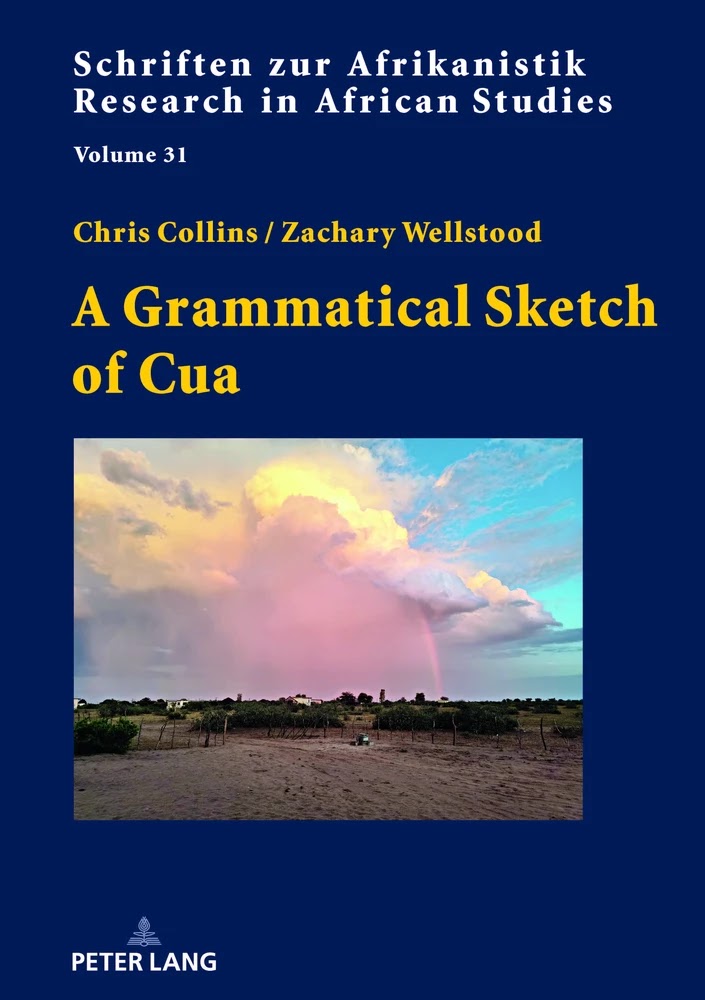
Collins, Chris and Zachary Wellstood. 2025. A Grammatical Sketch of Cua. Peter Lang. (https://www.peterlang.com/document/1499513)


Tuesday, December 17, 2024

A Grammatical Sketch of Cua

Summary

Cua is a Kalahari Khoe language spoken in southeastern Botswana (Kweneng District). It is closely related to languages such as G||ana, Tshila and Tsua. The phonology chapter describes the consonant, tone and vowel inventories, as well as a system of depressed tones following aspirated and voiced consonants. Later chapters provide concise overviews of the morphology and syntax of the language. Cua is characterized by a complex system of person-gender-number markers (PGN markers), which play a role in the formation of the pronouns. The features defining pronouns include: singular, dual, and plural number; first, second, and third person; and masculine, feminine and neutral gender. There is also a distinction between inclusive and exclusive first-person plural pronouns.

https://www.peterlang.com/document/1499513


Sunday, November 3, 2024

Biographical Notes (Technology Review, Class Notes, March/April 2025)

I wrote this for the Technology Review, Class Notes. It should appear in the March/April 2025 issue. There are also some pictures to accompany the text. They are pictures of me in the field. But I do not post them here.

Friday, August 9, 2024

Inversion and the Nominal Linker in Kua

Abstract: The linker in Kua relates modifiers (demonstratives, adjectives, possessors, relative clauses) to the head noun in the DP. I propose that the linker is the head of an LkP projection where NP moves into Spec LkP giving rise to an inverted word order. 

Keywords: linker, inversion, concord

Inversion and the Nominal Linker in Kua

Thursday, July 18, 2024

Writing the Sasi Dictionary: Some Personal Recollections

Introduction

Writing the Sasi dictionary was difficult. The purpose of this piece is to explain to a general audience (of non-linguists) why I found it so difficult. From this, they might get an idea of the challenges that a field linguist faces in their day-to-day work.

Saturday, July 13, 2024

Photos of Summer 2024 Tshila Expedition

A few photos of our recent NSF funded expedition in Botswana to document Tshila (a Khoe Kwadi language) during the summer of 2024.

The team standing in front of the village sign. From left to right, Kagiso, Chris, Andre and Akuwa. John David is not pictured since he had to leave a bit early. As can be seen, the village is built on sand in the Kalahari desert.


A picture of John David lounging on the back of my Toyota Land Cruiser, a super powerful vehicle that can drive through deep sand without even engaging the 4x4.


The next two photos are of our house in the village. After struggling with accommodation in Diphuduhudu, I realize how lucky we were to find this house, which we rented from one of the subchiefs. We really loved it. It was spacious with tiled floors, and some black couches in the living room. It had two bedrooms, a living room (the office), a shower room and a kitchen. The outhouse is pictured to the right, only a short walk from the main house, and pretty much reserved just for us. I paid them over the phone. So it was cozy and convenient.

Another view of the house with my beloved solar panel. We powered three computers, and countless phones, since the neighbors kept popping in for us to charge their phones. Only on the last few cloudy
days in the village did we face any real problem with solar power, but even then we managed to finish the day with enough power.


The photo below shows the fire where we would heat up water for showers (in order to make our gas supply last longer). The desert gets very cold at night and in the morning down into the 30s. It is really lovely to take a hot bucket shower after a long day at work.

A view of my work setup, including computer (powered by solar panel), Zoom H4n as audio-interface, notebook (I am old school, and enter everything in a notebook) and plenty of Setswana dictionaries.


A picture of me working with the consultants.

John David and Andre took a mini-expedition into Khutse to see the animals. Khutse is only a few kilometers from the village (less than five kilometers). The wild animals, including lions and elephants, sometimes make their way outside of the park into the village.

The bare shelves of the village store. This picture just highlights how difficult it is to buy food in the village. There are only a few tuck shops and this mostly empty store.

The incredible beauty of the Milky Way Galaxy at night. Never before have I seen such a beautiful display of the night sky.


NSF Fieldwork by the Numbers (2018-2024)

 This research reported on below was done under the NSF grant “Developing the next generation of researchers investigating Khoisan languages” (Award Abstract # 1760980). The duration of the grant was from June 1, 2018 to August 31, 2024. The grant was extended twice because of the pandemic.

Tshila Fieldwork 2024 by the Numbers

From May 27 2024 to June 28 2024, Andre, John David and I did fieldwork on Tshila, an endangered Khoe-Kwadi language spoken in southeastern Botswana. We did the fieldwork in Kaudwane, which is on the edge of the Khutse game reserve. The purpose of this note is to summarize the work done during our trip.

Monday, November 6, 2023

Two Abstracts for ACAL55 on Kalahari Khoe

Here are two related abstracts that I submitted for ACAL55 with co-authors. ACAL stands for Annual Conference on African Linguistics.

They both concern the classification of Khoe-Kwadi languages (Central Khoisan). The first deals specifically with Tshila, which has not been very well classified before. The second deals with the structure of the Kalahari Khoe subgroup of Khoe-Kwadi, arguing that it should be divided into northern and southern Kalahari Khoe. The methodology of the second paper is based on the Bantu linguistics paper by Marten, Kula and Thwala 2007. 

As of the posting date (November 6, 2023), neither abstract has been either accepted or rejected.


Batchelder-Schwab, Andre and Chris Collins. 2023. Classification of Tshila. 

Abstract submitted to ACAL55. Abstract.


Collins, Chris and Anne-Maria Fehn. 2023. Parameters of Morphosyntactic Variation in Kalahari Khoe.

Abstract submitted to ACAL55. Abstract.